


Before the City
For the vast majority of human history, the city did not exist. Humans lived in small, mobile groups — family-based bands or tribes — following seasonal migrations of animals and the ripening of wild plants. Survival depended on mobility, knowledge of the land, and cooperation within small social circles.
The first step toward city life came with the Neolithic Revolution around 10,000 BC, beginning in the Fertile Crescent. This was a sweeping transformation in how humans interacted with the environment: the domestication of plants like wheat and barley, and animals like sheep, goats, and cattle. People learned not only to plant and harvest, but to store surplus food for future use.
Storage changed everything. Grain in granaries was wealth that could last beyond a single season, but it also needed protection from pests, weather, and theft. This meant walls, watchtowers, and cooperative labor to build and maintain them. For the first time, settlements became worth defending — and worth staying in.
Archaeological evidence from Jericho (occupied as early as 8000 BC) shows stone walls more than 3 meters thick, enclosing the settlement, and a massive stone tower over 9 meters high. Whether the tower served as a lookout for defense, as flood protection, or as a ceremonial structure, its construction required organized labor and shared purpose on a scale unseen in earlier times.
Farther north, in what is now Turkey, Çatalhöyük (c. 7400–6000 BC) represents another major step toward urban life. Thousands of people lived in tightly packed mud-brick houses, their walls sharing support. The absence of streets is striking — residents moved across flat rooftops, entering homes through holes in the ceiling. Inside, walls were painted with hunting scenes, geometric patterns, and symbolic imagery. Some houses contained shrines with bull horns and skulls embedded in plaster, suggesting shared religious practices.
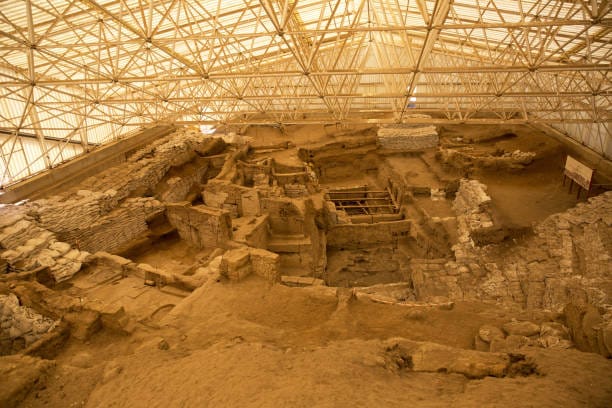
Despite their size, these settlements were not yet true cities. They lacked clear signs of centralized government, specialized professions beyond basic crafts, and large public architecture like temples or administrative buildings. They were socially complex villages — hints of what was to come.
Did you know?
A wall painting from Çatalhöyük may be the earliest known map, possibly showing the settlement with the nearby volcano Mount Hasan erupting in the background. Some archaeologists, however, argue it is purely symbolic.
The Urban Revolution
By the fourth millennium BC, especially in southern Mesopotamia, a new pattern of settlement appeared. Villages grew into something qualitatively different: cities. The British archaeologist V. Gordon Childe famously called this transformation the Urban Revolution.
In Childe’s model, the characteristics of a true city included:
- Large, dense populations
- Full-time specialists in crafts, trade, and administration
- Monumental public buildings
- A ruling authority and organized religion
- Systems of writing and record-keeping
- Long-distance trade networks
In reality, early cities did not always match every point of the model — but southern Mesopotamia came close.
Agricultural surpluses allowed part of the population to stop farming entirely. These people became potters, metalworkers, textile producers, merchants, soldiers, priests, and scribes. Specialization brought efficiency, but it also created interdependence: one person’s livelihood depended on many others fulfilling their roles. This complexity required coordination — and coordination demanded institutions.
Two main institutions emerged to manage city life.
The temple acted as both religious and economic center. Temples owned farmland, collected offerings and taxes, stored grain, and organized labor for construction and agriculture. Priests oversaw both sacred rites and economic management.
The palace was the seat of secular authority: the ruler’s household, military command, and center for diplomatic relations.
One of the most important inventions in early cities was writing — not for literature, but for accounting. The earliest clay tablets from Mesopotamia list grain deliveries, livestock counts, and worker rations. Writing allowed obligations and agreements to survive memory, providing a permanent record that could be checked, audited, and enforced.
Uruk — The First Great City
Around 3500 BC, the city of Uruk (in modern-day Iraq) emerged as the first true metropolis. At its peak around 3000 BC, it covered more than six square kilometers and may have housed between 40,000 and 50,000 people — a staggering number for the ancient world.
The city was dominated by two monumental religious complexes. The White Temple stood atop a ziggurat dedicated to Anu, the sky god. The Eanna Precinct, devoted to Inanna, goddess of love and war, contained a vast collection of temples, courtyards, and storage facilities. These were not just houses of worship — they were also administrative headquarters, economic centers, and symbols of collective identity.
Massive defensive walls surrounded Uruk, later immortalized in the Epic of Gilgamesh:
"Go up on the wall of Uruk and walk around. Inspect the foundation platform and scrutinize the brickwork. Is it not of burnt brick and good?"
Inside these walls, life was bustling. Markets sold goods from far-off lands: lapis lazuli from Afghanistan, cedar wood from Lebanon, copper from Oman, and shells from the Persian Gulf. Craftsmen worked in specialized districts, producing pottery, textiles, and tools. Scribes recorded every transaction in cuneiform, a writing system still in its infancy.
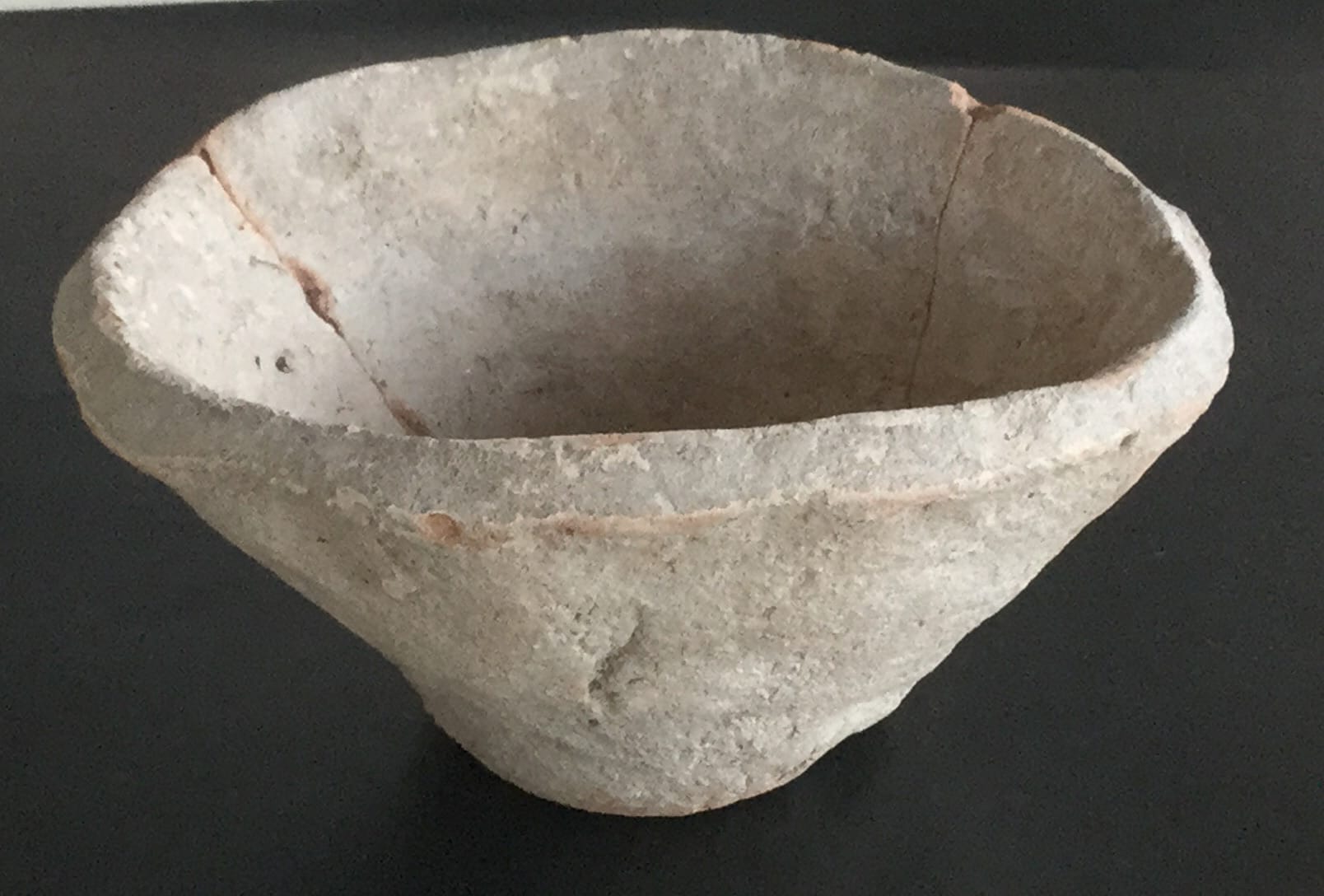
Archaeologists have found thousands of identical bevelled-rim bowls, suggesting mass production for standardized rations — perhaps of grain or beer — given to workers. Such finds show that the city’s economy operated on a scale that required careful organization and distribution.
Did you know?
The bevelled-rim bowl is one of the earliest known examples of mass-produced pottery, indicating a centralized system for feeding large labor forces.
Uruk was not alone in Mesopotamia. Cities like Ur, Lagash, Eridu, and Nippur also rose, each with its own patron deity and political ambitions. They traded, competed, and sometimes fought. Warfare spurred the building of stronger fortifications and the creation of early law codes. The Code of Ur-Nammu (c. 2100 BC) is the oldest known, prescribing fixed penalties for specific offenses — a sign that rulers were trying to standardize justice in growing, complex communities.
Egypt’s River Cities
In Egypt, the city developed along very different lines. The Nile Valley’s geography — a narrow ribbon of fertile land bordered by desert — encouraged political unity rather than the fragmented city-states of Mesopotamia. Around 3100 BC, Egypt was unified under the first pharaohs.
Cities like Memphis and Thebes became capitals of a centralized state. Their function was not primarily commercial, but political and religious. Massive temple complexes dominated the urban landscape, serving as centers for worship, economic management, and administration. Temples owned large tracts of land, employed thousands of workers, and stored surplus grain to feed laborers and supply state projects.
The pharaoh, as both political ruler and divine figure, coordinated labor for monumental works: pyramids, temples, irrigation canals. Such projects not only demonstrated the ruler’s power, but also unified the population through shared labor and religious meaning.
Not all Egyptian cities were monumental. The workers’ village of Deir el-Medina, built during the New Kingdom, was home to the artisans who carved and decorated the royal tombs in the Valley of the Kings. This small but highly organized settlement had straight streets, standardized houses, water supply points, and even its own court system to resolve disputes. Remarkably, written records from Deir el-Medina preserve details of wages, absences from work, and even the world’s first recorded labor strike — when workers stopped until their delayed rations were delivered.
Did you know?
The Deir el-Medina strike (c. 1150 BC) shows that even in the rigid hierarchy of ancient Egypt, urban communities could assert collective demands.
The Indus Valley’s Planned Perfection
Between 2600 and 1900 BC, the Indus Valley Civilization built cities that still astonish for their engineering precision and urban planning. Among the best known are Harappa, Mohenjo-Daro, Dholavira, and Lothal, spread across a region larger than ancient Egypt and Mesopotamia combined.
These cities were laid out in grid patterns with streets meeting at right angles, often aligned with cardinal directions. Buildings were made from standardized baked bricks, suggesting centralized production and uniform construction codes. Covered drainage systems ran beneath the streets, and many houses had private baths and soak pits connected to these drains — amenities that would not be matched in much of the world until the modern era.
Public buildings included large granaries for storing surplus grain and, in Mohenjo-Daro, the famous Great Bath, possibly used for ritual purification. Industrial areas were separated from residential districts, reducing pollution and fire hazards.
Curiously, the Indus cities show no evidence of massive palaces or temples. Political power may have been collective or council-based, rather than focused on a single ruler. The still-undeciphered Indus script, found on seals, pottery, and tablets, limits our understanding of their governance and social hierarchy.
Uniform weights and measures have been found across the entire Indus realm, a clear sign of economic standardization and long-distance trade. Indus merchants reached Mesopotamia, where they were known as people of Meluhha, bringing exotic goods like carnelian beads, ivory, and cotton.
Did you know?
The dockyard at Lothal is one of the world’s earliest known, indicating that Indus cities were part of an extensive maritime trade network.
Other Early Urban Traditions
Urbanism was not unique to Mesopotamia, Egypt, or the Indus. Other parts of the world developed cities independently, each with distinctive features.
In China, the Erlitou culture (c. 1900–1500 BC) is often associated with the semi-legendary Xia dynasty. Excavations reveal palatial compounds, bronze workshops, and planned streets. Later, the Shang dynasty city of Anyang (c. 1250–1046 BC) had royal tombs, vast residential areas, and inscriptions on oracle bones — the earliest extensive Chinese writing system.
In the Americas, the Caral–Supe civilization in Peru (c. 2600–2000 BC) built monumental platform mounds, sunken circular plazas, and residential sectors, all without the use of ceramics or apparent defensive walls. In Mesoamerica, cities like San Lorenzo, part of the Olmec culture (c. 1200–900 BC), became centers of trade, religion, and political power.
In the Levant and Anatolia, fortified cities like Byblos, Ugarit, and Hattusa served as both political capitals and hubs of international trade. These cities left behind archives of treaties, trade contracts, and correspondence, revealing the diplomatic and commercial complexity of the Bronze Age.
Life in the First Cities
Daily life in early cities combined opportunity and hardship.
The social hierarchy was often stark:
At the top were rulers and their families, high-ranking priests, and wealthy merchants. Below them were skilled artisans, traders, and farmers. At the bottom were laborers, servants, and slaves.
Homes reflected this divide. Elite residences were spacious, with multiple rooms and courtyards, sometimes decorated with art and equipped with private wells. The poor lived in cramped mud-brick dwellings, often in the city’s outer districts.
Markets were lively, with goods arriving from distant lands. Temples often acted as banks, lending grain or silver at interest and storing valuables for safekeeping. Festivals brought the community together in processions, feasts, and religious rituals that reinforced civic identity.
Did you know?
In Mesopotamia, workers were often paid in beer — a staple food and safer to drink than untreated water.
Challenges and Collapse
The first cities faced constant threats to their survival. Overcrowding and poor sanitation could lead to disease outbreaks. Irrigation mismanagement in Mesopotamia caused soil salinity to rise, reducing crop yields.
Warfare was frequent. Cities fought over fertile land, trade routes, and political dominance. Archaeologists have found arrowheads embedded in ancient walls, physical evidence of sieges and battles.
Around 2200 BC, the 4.2 kiloyear event — a period of global climate instability — brought drought to many regions. In Mesopotamia, it coincided with the collapse of the Akkadian Empire. In Egypt, the Old Kingdom entered a period of decentralization. In the Indus Valley, urban centers declined, possibly due to changing river patterns and environmental stress.
Some cities adapted and recovered; others were abandoned, leaving only ruins to mark their existence.
The Legacy of the First Cities
Despite their fragility, the first cities created lasting institutions and ideas that still shape our world:
- Writing systems for administration, literature, and law.
- Governments capable of coordinating large-scale projects.
- Monumental architecture as symbols of collective identity.
- Standardized measures to facilitate trade.
- Civic identity — the sense of belonging to a shared community.
Modern cities, with their skyscrapers, transport networks, and digital infrastructure, are direct descendants of these early urban experiments. The challenges they faced — managing resources, keeping peace, balancing growth and sustainability — remain at the heart of urban life today.
The mud-brick walls of Uruk, the temples of Memphis, and the gridded streets of Mohenjo-Daro are more than archaeological sites; they are the foundations of human civilization.


